State of California, a legal drama is playing out that seems part constitutional law exam and part high-stakes spy thriller. On Monday, a federal judge in Los Angeles got involved, issuing a split decision that had everyone from immigration advocates to federal agents checking their rearview mirrors.
At issue are two pieces of bills intended to pull back the curtain on law enforcement: The “No Secret Police Act” and the “No Vigilante’s Law.” One slammed into a judicial brick wall, the other passed through open gates, paving the way for a seismic change in how police — local and federal — engage with residents on California soil.
The Verdict: Masks Stay (For Now), Badges Come Out
U.S. District Judge Christina Snyder issued a preliminary injunction that essentially puts a “pause” button on California’s attempt to ban federal agents from wearing masks. However, in the same breath, she gave the green light to a law requiring every officer to show their “receipts”—specifically, their name and badge number.
Quick Summary of the Ruling
| Provision | Status | What it Means |
| Mask Ban | Blocked | Federal and local officers can still wear facial coverings (balaclavas, gaiters). |
| ID Requirement | Upheld | Officers must display clear agency identification and badge numbers. |
| Effective Date | Feb 19, 2026 | The ID requirement becomes enforceable immediately. |
Why the “No Secret Police Act” Failed the Constitutional Smell Test
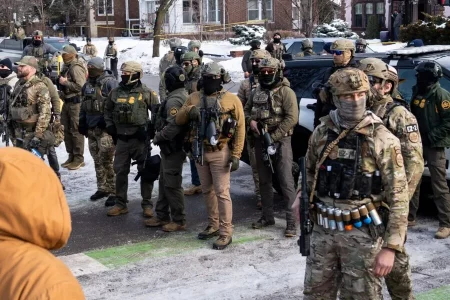
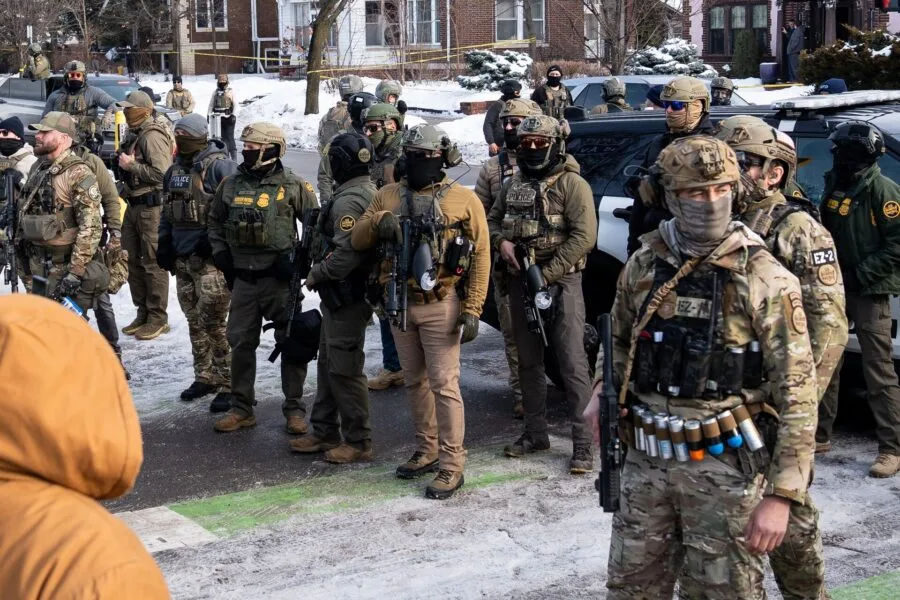
Let’s be honest: the name “No Secret Police Act” sounds like something out of a dystopian novel. Authored by State Senator Scott Wiener, the intent was clear: prevent law enforcement from looking like anonymous tactical units. The law aimed to ban facial coverings like ski masks and neck gaiters during operations, specifically targeting U.S. Immigration and Customs Enforcement (ICE) and other federal agencies.
The Discrimination Trap
Judge Snyder didn’t block the mask ban because she has a personal fondness for balaclavas. She blocked it because of how the law was written. As it stood, the ban applied to federal and local officers but conveniently exempted state law enforcement.
In the eyes of the court, this was a massive “no-no” under the Supremacy Clause of the U.S. Constitution. You can’t tell the federal government they have to follow a rule that your own state police don’t have to follow. That is classic discriminatory treatment.
The Logic of the Court
-
Uniformity: Laws affecting federal authority must be applied even-handedly.
-
Supremacy: States cannot undermine federal operations by imposing unique restrictions that don’t apply to state-level counterparts.
-
Safety vs. Transparency: While the state argued for transparency, the DOJ argued that masks protect officer identities in sensitive operations.
The “No Vigilantes Act”: A Win for Accountability
While the mask ban is on ice, the “No Vigilantes Act” is moving full steam ahead. Starting February 19, 2026, any law enforcement officer operating in California—whether they are a local sheriff’s deputy or a federal ICE agent—must display:
-
Their agency name.
-
A visible badge or ID number.
This part of the law was upheld because it applies broadly and fairly. It doesn’t single out the feds; it tells everyone in uniform that the “anonymous hero” (or villain) trope is over. If you are performing a duty that involves the public’s civil liberties, the public has a right to know who is behind the vest.
“Accountability isn’t a suggestion; it’s a requirement for a functioning democracy,” Gov. Gavin Newsom noted, highlighting the identification requirement as a major step forward for transparency.
The Role of ICE and the Federal-State Friction
It’s no secret that California and the federal government have been in a “cold war” over immigration policy for years. California’s “Sanctuary State” status often puts it at odds with ICE operations.
Why the Feds Sued
The U.S. Department of Justice (DOJ) filed its lawsuit in November, arguing that the “No Secret Police Act” was a direct attack on federal authority. They argued that:
-
Operational Security: Masking is often necessary for undercover agents or those working in high-risk environments where retaliation is a threat.
-
Interference: By banning these tools, California was effectively trying to dictate how federal agents manage their own safety protocols.
The court agreed that, at least in its current draft, the law overstepped. However, this isn’t necessarily the end of the road for the mask ban.
Senator Scott Wiener’s Next Move: The Rewrite
If you thought State Senator Scott Wiener would take this sitting down, you haven’t been following California politics. Wiener has already signaled his intent to revise the legislation.
The plan is simple: Apply the mask ban to everyone. By removing the exemption for state police, Wiener aims to close the legal loophole that Judge Snyder identified. If state troopers can’t wear masks, then the argument that the law discriminates against federal agents loses its teeth.
What a Revised Law Might Look Like:
-
Universal Application: A blanket ban on facial coverings for all law enforcement (Local, State, and Federal).
-
Safety Carve-outs: Potential exceptions for extreme weather, health reasons (like N95 masks), or specific high-risk tactical situations that are clearly defined.
The Human Element: Why This Matters to You
Imagine you are a resident in a neighborhood where a law enforcement operation is taking place. You see individuals in tactical gear, faces covered, guns drawn. Without visible badges or identification, there is no way to tell if these are legitimate officers, private security, or something more “vigilante” in nature.
Transparency builds trust. When citizens can identify who is at their door, the likelihood of escalation decreases. On the flip side, officers argue that in an era of “doxing” and social media, their privacy is their protection.
The Balance of Power
-
The Pro-Mask Argument: Protects officers from being identified by criminal syndicates or harassed online.
-
The Anti-Mask Argument: Prevents “anonymous” policing, which has historically led to civil rights abuses where officers cannot be held accountable for their actions.
Legal Precedents and the Supremacy Clause
To understand why this ruling happened, we have to look at the Supremacy Clause (Article VI, Clause 2) of the U.S. Constitution. It establishes that federal law takes precedence over state laws when the two conflict.
In the case of California v. United States, the courts have often ruled that while states have “police powers” to regulate health and safety, they cannot use those powers to intentionally obstruct federal agencies from carrying out their duties. By exempting state officers from the mask ban, California essentially admitted that the law wasn’t just about safety—it was about targeting the feds.
Looking Ahead: What Happens on February 19?
As of February 19, 2026, the landscape of California policing changes. You can expect to see:
-
Clearer Branding: More prominent “ICE,” “FBI,” or “POLICE” patches.
-
Visible Numbers: Badge numbers displayed on the outermost layer of tactical vests.
-
Legal Challenges: Likely more litigation as federal agencies test the limits of the ID requirement.
Expert Opinion: Will the Mask Ban Eventually Pass?
Legal analysts suggest that if Senator Wiener successfully removes the state exemption, the law will have a much higher chance of surviving a court challenge. However, the DOJ will likely still argue that any state law interfering with federal safety equipment (even if applied to everyone) is an unconstitutional burden.
Conclusion: The Path to Transparency
The ruling by Judge Christina Snyder is a classic “split the baby” decision. It reinforces the importance of the U.S. Constitution’s Supremacy Clause while validating the public’s demand for basic accountability through identification.
California remains the primary laboratory for police reform in the United States. Whether it’s body cameras or badge visibility, the state is determined to ensure that no one—not even federal agents—operates in total anonymity.
Sources & References:
-
U.S. District Court, Central District of California: DOJ v. State of California (2025-2026).
-
California State Legislature: SB 10 / AB 1254 (The No Secret Police Act).
-
U.S. Constitution: Article VI, Clause 2 (The Supremacy Clause).
-
Office of Governor Gavin Newsom: Press Release on Law Enforcement Transparency.